
Buy Bonds, Duck Bombs
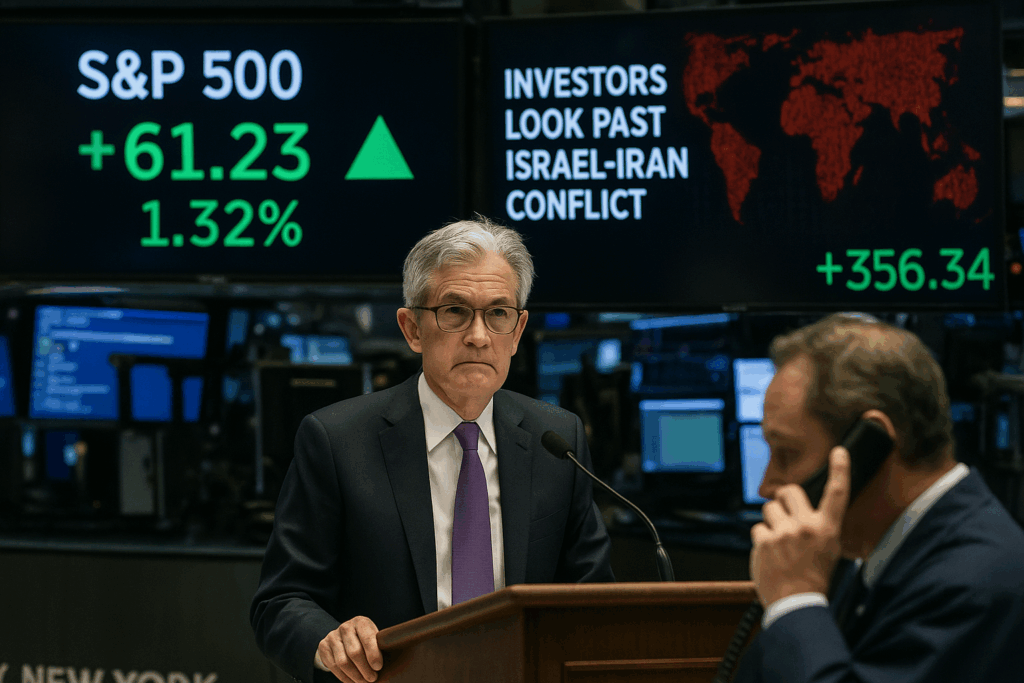
I have to admit that ever since I started working in this field, I’ve always been amazed at how we can go from laughter to tears in a matter of minutes. Normally, that’s something you’d say about an actor—but here, we’re talking about an entire market. Last night, I came across a sentence that made me want to roll on the floor laughing. A sentence so absurd, it proves we have the IQ of a spoiled mussel and that yes, we are capable of going from laughter to tears in under 12 minutes. The sentence is:“The S&P 500 closes higher. Investors begin to look past the conflict between Israel and Iran.” It’s M-A-G-N-I-F-I-C-E-N-T. You have to admit it’s quite something to see that just four days after hostilities began, stock markets have already sized up the conflict and switched into “don’t care” mode. Oil is back around $70 or so, defense stocks are getting smashed, and oil companies are under pressure because ALL THE EXPERTS SAY: Iran won’t close the Strait of Hormuz, so oil at $80, or $120—or even $150—is clearly overhyped. And on top of that—fabulous news—Iran already seems ready to negotiate. At least, that’s what the Wall Street Journal claimed yesterday, which was immediately confirmed by Trump. The President thinks the Iranians should have thought of that sooner, but still left the G7 to try to broker a peace deal between the two sides. His spokesperson, Emmanuel Macron, announced it to the press yesterday… We already talked about this a few days ago: every armed conflict brings its initial wave of panic, but it always ends in a bull market. Still, to think we’d bounce back so quickly—when the Iranian military is threatening a fiery apocalypse via tweets on X—felt far-fetched. Yet here we are: Wall Street and other global markets ALREADY got their smile back and resumed their upward march. After briefly freaking out over Israeli strikes on Iran, the markets basically said:“Well, maybe it won’t turn into World War III just yet.” The result: the Dow Jones rose 317 points, the S&P 500 climbed 0.9%, and the Nasdaq jumped 1.5%. In Europe, the DAX rose 0.78%, France gained 0.75%, and Switzerland was down 0.45%—because apparently we no longer need a safe haven now that war is no longer interesting. But careful, the mood is still tense: people were already nervous before the war due to tariffs, so if oil takes off again, inflation could still be a serious issue in the coming weeks. The Fed meets today for two days. They’re not expected to touch interest rates, but all eyes will be on Powell’s press conference Wednesday. Because right now, one wrong word… and it’s total panic again. The war isn’t over, though Still, as I said at the beginning of this piece, the market has already priced in the Iran-Israel war and moved on. What happens next in the real conflict is still a big question mark, but for now—as long as it doesn’t get worse than what we already know—there’s no reason to panic. That said, I’d like to point something out: yesterday, the Iranian military promised to launch so many missiles on Tel Aviv that it would be unlike anything ever seen in history. And, by the way, you could even watch the bombing live yesterday on The Sun’s website. We’ve reached the point where live bombing streams are being broadcast. If anyone was wondering whether humanity could sink lower in its mediocrity and depravity—I think we have our answer. So, Iran wants to negotiate, Trump wants to get involved, and in the meantime Israel is bombing Iran’s national TV station, and Iran claims to have shot down 4 F-35s—which Israel says is fake news. Anyway, I’m no expert, but this doesn’t exactly look like a ceasefire within 48 hours followed by embassy reopenings next week. But since markets have decided they no longer care, let’s move on. Because THE FINANCIAL AND ECONOMIC EVENT OF THE WEEK is clearly the Fed kicking off its two-day meeting in just a few hours. So let’s talk about the Fed and Jerome “Too Late” Powell. The FED The Fed has been in “wait and see” mode for a while now, and we all know it. But why is the Fed just observing and not doing anything? Well, because out there, it’s a real mess — and if I had to choose between smashing both my knees with a hammer or taking Powell’s job, I’d say: “WHERE THE HELL IS THAT HAMMER?!” Between a trade war that never really ended and an actual war in the Middle East (even if we stopped caring for the past 24 hours and investors are starting to look beyond the Israel-Iran conflict — as someone once said), the U.S. economy is limping along. Growth is slowing, companies are pulling back on hiring, and consumers are hesitant to pull out their credit cards. Cards that are already maxed out at rates that would make the Corleone family jealous. You can imagine that Powell’s job isn’t easy, even though it basically boils down to: “Do I cut now or later?” — with a side note: “What if I have to raise rates again to re-cool inflation?” The equation is relatively complex, full of unknowns, and one certainty: if nothing changes, Trump could very well launch Operation RISING LION — not on Tehran, but on the Fed and Powell himself. So the Fed is expected to keep rates unchanged tomorrow night, while keeping a close eye on inflation, which will likely dominate headlines in the coming weeks. For now, inflation is holding steady around 2–2.5%, but if it starts climbing again — say goodbye to the rate cuts Wall Street is hoping for. In short, the fog is thick… and everyone is scrutinizing the Fed’s forecasts like Powell has the power to change the world. One thing’s for sure: this well-timed conflict isn’t making Powell’s job any easier. Even if Wall
Markets on Prozac

Right. I’ll be honest with you: right now it feels like we’re just going in circles. We’re talking about tariffs with China that are supposedly settled, but no one really cares, even though we’ve been waiting on that for three weeks. Inflation is rising again, but not as much as we thought it would—which is good news—but let’s not get ahead of ourselves, because the REAL INFLATIONARY IMPACT is still coming… sometime later. We just don’t know when exactly “later” is. So after waiting all week to LEARN something, it feels like we’re just being told that it’d be nice to wait a little longer. Exhausting. Title: “Putting Things in Order (or Not)” Let’s try to sum things up while staying focused: markets ended slightly lower across the board. But these were mild declines, the kind that make it feel like everyone’s already left for vacation and will be back in September. Yet, given the avalanche of news we had to digest yesterday, it’s puzzling why there’s so much disinterest, so much “don’t care” energy, and why the markets felt as dull as the sky, which is full of smoke from Canadian wildfires. We started the day with a photo. A photo of the six negotiators who “saved the world” from a tariff war. A stairwell shot showing three Americans and three Chinese looking pretty pleased with themselves, saying nothing because they had to report to their bosses first—since in the end, those are the ones with power over life and death decisions. But what we did know was that they had a principle agreement. So markets opened with a “well, that’s nice, but let’s wait and see” vibe. And “wait” meant waiting for the CPI release—to see if Uncle Donald’s tariffs had already started eating into U.S. consumer spending. Let me tell you right now: the answer is “yes, but not as badly as expected, but let’s not get too excited because more pain is coming”—these are the words of experts who are allowed to change their minds every five minutes depending on the wind, weather, and whatever the President says. The American President, of course. The CPI: Less Bad Than Feared Let’s start with the CPI. The long-awaited number came in… up. But less than expected. Contrary to fears that Trump’s Jenga-tower-like tariffs would skyrocket inflation, it actually slowed down. Year-on-year, we’re at +2.4%. Yes, that’s a bit higher than April’s +2.3%, but lower than the expected +2.5%. Experts immediately jumped in to say it was “below expectations,” but that it was only a temporary relief BECAUSE THE TARIFF IMPACT IS STILL COMING. We just don’t know when. Maybe now. Maybe end of the month. Or the summer. Or never. In short, nobody knows—but “it’s coming.” So the news was GREAT! Another GREAT reason for markets to go up! Right?Wrong. Because the tariff impact is still coming.So basically, the GOOD CPI NUMBERS are useless for now, and it’s better to wait a little longer to see when the real pain kicks in. Maybe the core inflation was okay—it came in at 2.8%. But you get the idea: for now, inflation is under control, but we fear the worst is yet to come. Still, on Trump’s side, everything’s “under control”—except Los Angeles. Trump was quite busy yesterday but still found time to announce that (in his opinion) the inflation figures were “EXTRAORDINARY AND THAT THE FED SHOULD CUT RATES BY 100 BASIS POINTS!!!” No, you’re not dreaming. You’re not reading last week’s notes:Trump actually REPEATED HIS DEMAND for Powell to cut rates by 100bps.And guess what? The Fed meets next week. So in conclusion:Yesterday’s inflation was not as bad as feared – but markets prefer to wait.Wait to find out WHEN THE TARIFF PAIN hits and to learn more about the MAGIC DEAL with our new Chinese friends. The Deal in Detail—Or Not Speaking of the MAGIC DEAL with our new Chinese friends: Trump spoke yesterday—which, let’s be honest, isn’t surprising. What would be surprising is if he stayed quiet for two weeks and gave us a break to focus on other topics and people. Anyway, Trump spoke, and when he speaks, it’s truth.Well… his truth. The U.S. President proudly declared that the trade war with China is “over.”Champagne and caviar for everyone. Except that, in reality, it’s like declaring a storm over when you still have water up to your knees and your roof blew away 80 kilometers. Officially, the deal is “done.”Unofficially, Beijing hasn’t confirmed anything—just vaguely reiterated the “Geneva consensus.” Translation: we’re basically back to where we were before.Which is to say: nowhere.Well, not exactly nowhere—I’m probably just jaded. But when Trump says the deal includes 55% tariffs (more or less the same as before, since Biden already slapped on 25% and Trump added another 30%), you don’t really get the feeling that it’s time to quote Steve Jobs and shout: “THIS IS A REVOLUTION.” Clearly, it’s not. So: the punitive tariff on Chinese imports stays at 55%.We’re not going any higher. Great, right?Well… no. Because 55% tariffs are already a noose for thousands of companies.And I’m not the one saying that—it’s the logistics industry, retailers, and CEOs fighting for margins. One CEO from a major retail chain summed it up bluntly:“This is not a win for America.” Supply chains are already broken. Job losses are already real. Price hikes are inevitable (which brings us back to June’s CPI—but we’ll talk about that again in July). Overall, just saying “it’s over” doesn’t fix anything.Logistics leaders are clear: the damage is done. The wound is deep, and it’ll keep festering in the coming months—just in time for back-to-school and the holiday season. And Who Pays? In summary, the deal is signed—well, it will be once the Chinese confirm it, which they haven’t yet. But one thing is certain: the American consumer is going to foot the bill. Because at 55% tariffs, you have two options: Raise prices. Cut costs. (Translation: lay people off.) Either way,
Wall Street: Soap Opera
You all know that for quite a few months – if not years – investors’ outlook has gradually narrowed to the very short term. The overwhelming amount of information we’re bombarded with every day makes us focus much more on the short term, or even the immediate, rather than holding on to a long-term vision and building over many years. No. Today, we want everything—and preferably, yesterday.As a result, our behavior has changed, and we no longer live by visions of the future, but rather by expectations of what will happen this week—or better yet, today.We live from one figure to the next, and this Wednesday morning, more than ever. Waiting, Always Waiting This start of the week perfectly embodies what we’ve been experiencing for months in the wonderful world of finance: we’re waiting for a number or a major announcement as if it would definitively shape the construction of our portfolios. Every macroeconomic announcement—or worse lately, geopolitical news—is treated as a game changer that will define the trajectory of our lives for the next 20 years. The trajectory of our investor lives—let’s be clear. When it comes to making life choices as human beings, thankfully we still have social media and artificial intelligence. Speaking of which, yesterday proved just how helpless we’ve already become without AI. ChatGPT went down, and many of us had to use our brains again, suddenly realizing we’d become junkies addicted to our “digital slave,” and that without it, our productivity immediately tanks. But that’s not the point. What I wanted to say this morning is that we’ve been waiting for two things over the past two days: The outcome of the China–U.S. negotiations—to see how they plan to resolve their trade dispute and whether these 48 hours of talks will have any impact on inflation, and if so, by how much. The inflation figures themselves. Of course, the negotiations won’t have an immediate effect on the numbers coming out later today, but depending on what leaks from the London meeting, we’ll try to cross-reference both bits of info to figure out what to do with our portfolios.To be fair, during these two days of waiting (one for us in Switzerland, coming off a three-day weekend stuffed with lamb), we’ve learned at least one thing: in times of uncertainty—when your head’s in a bag and you have no idea what the next 24 hours will bring—our instinct is to buy. Doubt Still Lingers Now we have to see if the combination of the post-London meeting statements and this afternoon’s data will allow us to keep pushing forward—or not. What you should know this morning is that U.S. indices are inching closer to their all-time highs. Today marks the 78th trading session since those record levels. We’re now just 1.8% away from that goal… Will the inflation numbers and trade announcements be enough to seal the deal by tonight? That’s far from certain.What we currently know about the negotiations isn’t much. After months of tension and two days of talks in London, U.S. and Chinese negotiators seem to have found a “framework” to implement the Geneva agreement reached last month. And I say seem because we’ve been given practically zero information about the substance of the deal.All we’ve got is a “feel-good” photo of smiling negotiators. Howard Lutnick, U.S. Secretary of Commerce, and Li Chenggang, Chinese Vice Minister, confirmed that both parties had reached “an agreement in principle,” particularly on the rare metals issue. But again—no details. The agreement still needs to be validated by Trump and Xi before taking effect.As of Wednesday, June 11th, 5:00 a.m. Geneva time, no concrete details had leaked. Futures are down 0.25%, and markets remain skeptical. They’ve rallied for two days on the hope that the agreement is “good news” and a show of goodwill—but now they want something tangible. Not just a photo op with six guys laughing where you can barely tell who’s American and who’s Chinese—though we have a few clues. One thing’s for sure: there’s not much diversity in the delegation. Judging by the photo, gender balance was clearly not a priority.In short: we don’t know anything. We hope it’s enough to justify the recent rally and that maybe we can finally start doing some math and projecting further than just the end of the day.In conclusion: yes, there’s an agreement headed in the right direction, but it still needs to be signed off by the top bosses—and apparently, it can’t be done over Zoom, since everyone wants to go home and check with their superiors first before committing.We, however, would really appreciate something concrete. Justifying Speculation Let’s not forget that over the past 77 trading days, we got slammed on LIBERATION DAY, only to rebound 25% from the lows.Yes, 25%—or 1,236 points up since April 7th—this is the third-strongest rally in history over such a short time frame.Now we’ll have to justify it with more than just: “We have a vague framework for a deal, but no idea what’s in it, how it’ll be implemented, or what it’ll cost in terms of inflation.”Anyway, we’re at least happy they didn’t rip each other’s heads off over the past two days. That’s something. Now, we just wait. Again.One thing is certain—and I must say it:When you look at the press release after the trade talks—both in form and content—you really wonder if it would’ve been better to just shut up and keep waiting. Because right now, we know less than we did yesterday—and even less than we knew on Sunday night.And yet I’ve written two pages about it.So I’ll do the noble thing: I’ll shut up. But… One Thing We Can Talk About There is one area where we don’t know much, but we’re still allowed to put in our two cents: U.S. inflation, which is coming out shortly.But before anything else, let’s see what the experts in the wonderful world of finance are expecting: • Headline CPI (May):+0.2% month-over-month+2.5% year-over-year (vs. 2.3% in April)
Game of Loans
After a three-day weekend, it’s always a bit of a moment for reflection. Especially when you know that the rest of the world was more or less open — you kind of feel like you missed something. Yet the American and European markets kept going without us. Which, in turn, allows us to return this morning fresh and ready to analyze everything that happened over those three days. And to be honest, the main takeaway is that the markets are indestructible. And until we get more details on the outcomes of the U.S.-China trade negotiations and on inflation — particularly the impact of tariffs on inflation — we have no other choice but to keep going up. Monday Thoughts Before diving into the details of the recently published figures, I think it’s worth taking a step back to reflect on what’s going on right now. Let’s start with the U.S. indices, which are just a few points away from their all-time highs. Regardless of the actual economic situation in the U.S., the market is focusing on the geopolitical side — namely: tariffs and the many shows Trump puts on TV, the latest of which is the deployment of the National Guard to Los Angeles to calm down rioters or start an actual civil war. At the moment, Wall Street seems largely unconcerned by all this. But we can’t rule out the possibility that things could escalate quickly if members of Congress or the Senate begin to feel personally affected. This could quickly morph into another power struggle: the debt ceiling. Indeed, if Trump keeps falling out with everyone, even his most fervent supporters might feel like asking him to dial it down — through negotiations over the debt ceiling. Just as a reminder: a solution must be found before this fall, or the U.S. risks defaulting. Another Hot Topic: U.S.-China Negotiations Another issue keeping everyone on edge at the start of this week is the negotiations between China and the U.S. These talks began yesterday and are supposed to resume this morning. So far, there’s been no news, not a phone call, not even a postcard. For now, we’re clinging to the idea that “as long as they’re talking, it’s a good sign.” But let’s be honest: we need clarity. Ideally, we need more than yet another moratorium extension — we need a real deal, real clarity in the relationship between the two countries. In the meantime, China is virtually at a standstill, and each passing week makes things a little more complicated. The latest figures show that Chinese exports to the U.S. dropped by 34% in May. That’s the biggest hit since February 2020. It’s also the second consecutive month of decline — demand for Chinese products is collapsing. Moratorium or not. Let’s not forget that tariffs are still at 30%. At the moment, it’s worth noting that China is exporting massively to Vietnam, hoping to use the backdoor to reach the U.S. market. To put it simply, global trade isn’t in great shape due to tariff uncertainty, and Trump’s methods are beginning to show visible damage — not yet necessarily in the U.S., but for how much longer? Inflation and Tariffs We’re currently in wait-and-see mode regarding the tariff negotiations with China, and we still don’t know any more about what’s happening with Europe. Ever since Trump gave Ursula those sweet eyes, we haven’t heard a thing. So, we could say “no news is good news,” but at the same time, it kind of feels like we’re sailing blind in a stormy ocean filled with hostile creatures that could jump on us at any moment. People always say global markets hate uncertainty — and right now, we’re getting plenty of it. But that’s not all, because in the middle of all this, there’s also inflation lurking just around the corner. And this is another layer entirely — we’re no longer just watching inflation by itself, but also closely monitoring when tariffs will start impacting said inflation. Let me take a quick step back: ever since tariffs have become a major topic, the so-called EXPERTS IN FINANCE AND TRADE TARIFFS (who, by the way, can double as experts in pretty much any topic trending in the media) — these very experts told us that the impact would be felt in May — or June at the latest. Except that all the recent inflation numbers have pointed more toward a rather tame inflation, drifting back toward the 2% target. Yet with every new data release, the same experts come back and say: “Oh no, not yet — you’ll see the impact next month.” And then this morning I came across an article saying the impact might show up rather toward the end of the summer. And who knows, maybe before summer ends, they’ll reach a deal and the impact will never come. In the end, maybe Trump is right when he says there’s no inflation and that Powell is completely nuts for not cutting rates by at least 100 basis points… In any case, one thing is certain: we’ll have a chance to talk about this again this week, since the U.S. CPI is coming out tomorrow. All things considered, if we ask ourselves how the markets are feeling right now, it seems like nothing can shake our belief in this bullish trend. The fear that gripped us during Liberation Day on April 2nd is now under control — or at least buried deep inside us. Kind of like the monster that used to live under our childhood beds. And even if inflation does pick up again, it’ll be seen as “expected,” and Trump will surely find a way to calm things down — so record highs on the S&P 500 should be nothing more than a formality this week. A Mere Formality A formality — because the things that could make us doubt are already priced in, and no one wants to believe in a NO-DEAL scenario
Muskman vs Trumpman
The least we can say is that we didn’t get bored yesterday, and it doesn’t look like we’ll be bored this Friday either. And to think—we’re lucky there’s not two Trumps and three Elon Musks on this planet, otherwise my columns wouldn’t even be columns anymore; I’d have to do a 24/7 live broadcast just to keep up with everything. In any case, this time we won’t complain, because we’ve got mountains of things to talk about. Mountains that solve absolutely nothing and fix zilch—but at least they give us material to write scripts for the next Netflix season, which they’ll surely churn out sooner or later… The day was packed. First of all, the ECB cut rates as expected, and their communication was—as usual—vague. In short: rates probably won’t go lower… unless they need to. Deposit rate at 2%, inflation expected at 2% in 2025, weak growth—but hey, we’re smiling. Christine Lagarde did what Lagarde does best: “we’re cutting, but we might stop.” Translation: we emptied the first-aid kit, now we’re just hoping the wound heals on its own. Oh, and Lagarde also said she won’t leave her post before the end of her mandate—just to put those rumors about her heading to the World Economic Forum to rest. Her loyalty is touching, but really, it’s just that the WEF hasn’t added enough zeros to the check yet. Meanwhile in Germany, the construction sector is still in the ICU, but business leaders’ morale is through the roof—which is funny, because it lines up perfectly with the 1-trillion-euro blank check the new government signed to celebrate taking office.When spirits are high, it usually means everyone wants a slice of the cake. Bottom line: the DAX hit an all-time high, while Switzerland is still bored to death in its 250-point range, ending the day above 12,300—woohoo—while posting an unchanged unemployment rate at 2.8%. Thrilling, just like the SMI range. And to cap it all off, Paris was the only major index to close in the red. A light red—down just 0.18%—but the message was clear: the market didn’t like that the ECB hinted the rate-cut cycle might be over. Investors love the idea that the Central Bank is here to help. When they realize there’s not much help left to offer, teeth start to grind. The Soap Opera Then Trump spoke with Xi. Supposedly the most exciting news of the day… except, not really. The call was “constructive,” Xi invited Trump to China, Trump invited Xi to the US—we just hope they check their calendars beforehand, because it would be a bit awkward if Trump flies to Beijing while Xi is mid-flight to Washington.To sum it up: nothing new, just diplomatic small talk, some dinner invitations, and a joint statement to “continue negotiations” on tariffs. Yes, the same ones that have been completely stuck for the past two weeks. Result: they hyped up this phone call, and it turned out to be about as impactful on the global markets as Macron’s argument with his grandma the other day in Asia. Meanwhile, the markets are playing poker, and Wall Street is holding its breath for the jobs report like someone nervously waiting for a pregnancy test—pure anxiety. And now, the juicy part… Here comes the good stuff. The thing that actually moved markets and lit things up:The chronicle of a breakup. You thought Married at First Sight was the ultimate romantic suspense and peak reality-TV stupidity? Think again.Enter: the live broadcast of the BROMANCE EXPLOSION between TRUMP and MUSK—and yes, it’s all happening on X (Twitter). And it’s so consuming, so dramatic, that today I feel obligated to run a special edition inside the special edition, complete with BREAKING NEWS banners, for this episode of political-financial bromance gone wrong. Welcome to the latest chapter of this majestic series: When Trump divorces Musk: A friendship worth $150 billion down the drain Just three months ago, Elon Musk said of Donald Trump: “I love him as much as a straight man can love another man.” Fast forward to yesterday: the eccentric, ketamine-fueled, possibly autistic billionaire accused Trump of being linked to Epstein, blamed him for hiding all the documents, accused him of sabotaging the economy with a “pile of tax abominations,” and even threatened to unplug NASA’s rockets that are supposed to send American astronauts into space.And yes—all of this publicly, on X. But be warned—Trump is not sitting idly by. On his end, he’s threatening to cut $21 billion in federal contracts to SpaceX, like an angry father snatching away the car keys: “Since you’re messing around, you’re grounded!!!” Tesla has lost nearly $200 billion in valuation, with the stock down 25% since May 29. Trump Media dropped 8%. And the markets are fluctuating between nervous laughter and panic over Tesla. So how did two superstars—who had everything to gain by working together—manage to spark a mini-crash with just a few tweets? Honestly, it’s pretty simple: ego, power, an insatiable need for attention—and a whole lot of money. It all starts like a political fairy tale: Trump becomes President for the second time, and we can’t deny that it’s partly thanks to Musk. The Tesla CEO injects $300 million into Trump’s campaign, and together they dream of a world filled with electric cars, rockets in every corner of space, and increased tariffs on everything not Made in America. Trump rolls out the red carpet in return. Musk becomes a “special senior advisor,” moonlights as a government spending watchdog, and gets invited to the White House more often than the DoorDash delivery guy. Everyone wins. Since LIBERATION DAY, Tesla has rebounded 69%. SpaceX pockets billions in contracts. And Trump gets to play the tech-messiah while insisting ELON is so amazing it’s almost embarrassing. He even organizes Tesla commercials in front of the White House, and Musk spends more time at Mar-a-Lago than at Tesla’s board meetings. Chapter 2 – The Uncontrolled Explosion This is when the “Bill” arrives. And no, we’re not talking
Elementor #16932

I’ve told you before and I’ll say it again: I’ve decided to be permanently optimistic and to reflect the joy of living at every moment. I promised you I would only see the glass as half full — and that half-full glass, I’ll now only see it filled with champagne or, at the very least, with fine Bordeaux or perhaps a Meursault. In any case, I will no longer speak of what’s not going well or about figures that might possibly, maybe, suggest we’re in a zone where one might be tempted to say it’s “the calm before the storm”… But then again, I’m not the one in charge of the macroeconomic calendar, and when you look at yesterday’s numbers, it’s still not going to be easy… It’s not my fault!!!Yes, staying optimistic isn’t going to be easy, but it’s not my fault. I wasn’t the one who published such a crappy Beige Book showing that things are slowing down pretty much everywhere. If you look at the economic weather map, you’ll see that going from west to east across the United States, we go from economic contraction in Los Angeles to Kansas City, then from Texas to Tennessee there’s zero growth, and the rest — in the East — is experiencing “soft growth.” Honestly, when you look at that map the Fed published yesterday, it doesn’t exactly inspire confidence that everything’s going just fine. And repatriating 3 factories and creating 500 jobs isn’t going to fix things. We’ll need more than that. Maybe by cutting rates very, very quickly — but once again — Powell won’t do anything unless he’s absolutely sure inflation is under control. And as long as we don’t know what kind of tariff storm is coming our way, it’s hard to see how any of this could work. Yet, despite the doubts that yesterday’s economic data so clearly justified, the markets didn’t crack and are still rising. Or at least… not falling. So, should we say this is the calm before the slap in the face? Hard to tell — especially for someone like me who’s self-labeled “bullish forever.” Some will say we’re already knee-deep in economic crap, but everyone’s just looking the other way and thinking: “No worries, it’s just a temporary dip…” The U.S. economy in May is a bit like this: the engine is sputtering, the driver’s pretending not to notice, and everyone’s just hoping the downhill slope will get the car going again. But when the tank is empty, it’s empty. Your gas tank isn’t going to refill itself by the grace of the Holy Spirit or Saint Mar-a-Lago. And now, we’re clearly seeing more and more signs that we’re running on fumes. I shouldn’t even be saying this (since I’m supposed to be FOREVER OPTIMISTIC), but what we saw yesterday doesn’t make you want to pop the champagne and smear caviar on your salmon toasts. Unless it’s to forget. Beige isn’t so beige anymoreThe Fed’s Beige Book — that compilation of economic surveys — made the color crystal clear: 9 out of 12 U.S. districts are in “soft growth” mode, or have no growth at all. Consumers are spending less, businesses are slowing down hiring, home prices are stagnating, construction is losing steam, and wages are starting to slam the brakes. The mood is gloomy — and definitely not rosy — with a scent of “I’m not panicking, but I’m softly considering it.”This slowdown isn’t just economic, it’s psychological. The uncertainty around tariffs, political back-and-forth, and unclear prospects are making everyone cautious. It’s like an empty nightclub at 1 a.m.: the lights are on, the music is playing, but no one dares step onto the dance floor.The markets are still keeping up appearances, but the economic reality — whether we like it or not — is catching up with us.And I swear, for an unwavering OPTIMIST like me, it hurts to say it. And it’s not the ADP numbers that are going to cheer us up.Yes, I know — it’s not the number that will change the world, and everyone’s eyes are already locked on its cousin, the Non-Farm Payrolls, but still. Yesterday, we were told only 37,000 private jobs were created in May, when we were expecting three times as many. That’s the weakest reading in two years. Now, when I say “weakest in two years,” I’m not talking about economists missing the forecast — that’s routine. I’m saying it’s genuinely low. It hasn’t been this bad in two years. For economists, it’s a bad omen for tomorrow’s NFPs. Whispers are suggesting 125,000 jobs at best — well below the 153,000 needed to keep unemployment at 4.2%. And let me say it straight — we’ll talk again on Monday — but if the NFPs come in above 150,000, it will be official confirmation that the data is rigged and these numbers are just shiny lies sold at a premium by the BLS. Look at the Beige Book, look at the ADP numbers. Read everything about how companies are hesitating to hire with all the uncertainty around tariffs and the economic slowdown. I CAN’T BELIEVE THE NFPs WILL BE GREAT TOMORROW! (Even though I am resolutely optimistic and bullish on the markets until the end of time, amen.) Wall Street: Collective denial or full-on delusion?Meanwhile, Wall Street is partying like nothing’s wrong. The S&P 500 is flirting with record highs — okay, it’s not FULL-ON EUPHORIA, but it’s creeping up, and tech stocks haven’t looked this good in weeks. Still, we’re seeing a subtle shift toward defensive names. It’s like investors are dancing on the Titanic but slowly edging toward the lifeboats, “just in case.” All in all, it’s holding up pretty well and “looks solid enough.” As if, right now, it’s more dangerous and painful to miss the rally than to get caught in the thresher when the drop finally comes. I might even believe that — if I were even slightly pessimistic. But thank God I’m not.
Titanic 2: Now,There’s WiFi
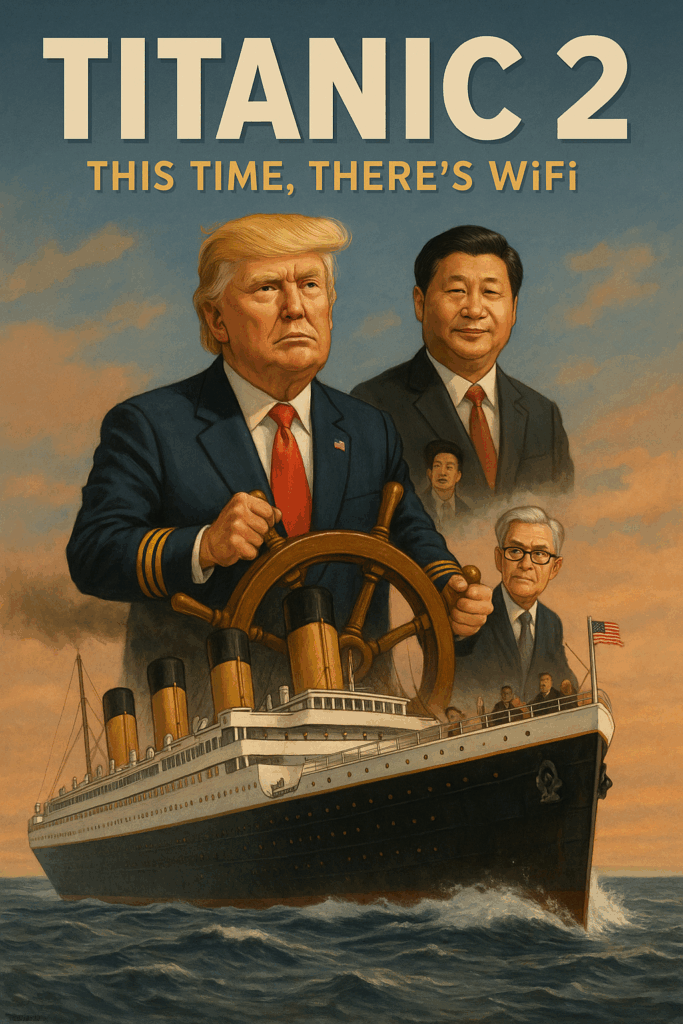
Alright, it’s done. This whole pricing story is falling by the wayside and we’re busy building a conviction that everything’s going to be fine. What am I saying? EVERYTHING IS GOING TO BE JUST FINE. For now, tensions between China and the US are tight as a thong, but the CONVICTION is strong and deep — Trump and Xi will talk. And not only will they talk, but ON TOP OF THAT, it’s going to go well. Then, jobs are looking cheerful after the JOLTS, and Friday’s probably going to be cheerful too. And on top of all that, with inflation going down, who knows — maybe Powell will cut rates in 10 days. I used to be cautious. Now? I don’t care anymore. Wildly OptimisticOver the past few days, I’ve been bombarded with comments saying I’m too negative, too cautious, and only ever talk about things that aren’t positive. So that’s it — I’ve made a decision: no more seeing the glass half empty. I’m switching to half-full mode. After all, it’s pretty clear now that markets don’t give a damn about bad news. The only thing they care about is what’s going well — or, even better: WHAT’S GOING TO GO WELL SOON. Yes, because right now, optimism is practically mandatory. If you’re not optimistic, you’re out. So let’s stop flirting with the dark side of the Force and instead focus on the thrilling, exciting currents of the BULL MARKET forever. And the timing couldn’t be better! Yesterday, the Nasdaq turned positive for the year, the S&P 500 is up 1.5% since January 1st, and the rest of the world has been on fire for ages — don’t even get me started on the DAX — it’s total euphoria! EVERYTHING IS FINE. Full employment, inflation under control. After flirting with 2% on last Friday’s PCE, it even dropped below 2% in Europe yesterday. And in Switzerland? Even better: for the first time since spring 2021, the Federal Statistical Office observed a year-on-year decline in consumer prices. Apparently, unlike April, rising rents weren’t enough to offset falling energy prices. At this rate, it’s becoming so cheap to fill up your tank in Switzerland that I honestly don’t see the point of buying an electric car anymore. In fact, I’m trading in my V6 for a V8 — one that guzzles fuel like there’s no tomorrow! We have to support the oil industry, after all. What a Wonderful WorldNo, seriously — we are living in a glorious, mythical era. Nothing can stop us. We’ve even managed to forget about tariffs. Nobody cares anymore — it’s practically ancient history. Even if nothing has been signed yet, you’d have to be a complete idiot to believe that agreements won’t eventually be reached. Take China, for instance. Dialogue’s broken down, both countries think the other is a traitor, and each accuses the other of trampling all over the Geneva Agreement — which, by the way, totally justified the marathon-day traffic jams in town, just so they could sit on the deal three days later. But I digress. The key takeaway? Right here, right now, they politely hate each other — but EVERYONE IS CONVINCED that the two world leaders will talk before the week is out, fix everything, and come out of it besties, licking each other’s feet so enthusiastically that it’ll be borderline awkward. Conviction is running so high that we’ve basically erased the entire “tariff era,” which now feels like a mere intermission in the world of finance. On April 4, 2025 — 61 days ago today — the media were practically screaming in panic. Back then, people were seriously wondering: SHOULD WE LIQUIDATE OUR PENSION FUNDS AND GO ALL CASH? Because Trump was nuts. And that was the polite version of “nuts.” But today? Nobody gives a damn. Trump hasn’t quite reached “intergalactic genius” status just yet, but if he strikes a deal with Xi Jinping by the end of June and manages to pressure Powell into cutting rates (without breaking his knees or kidnapping his family — just to be clear), I’d say there’s a decent chance the Vatican will revise its iconography and start replacing saint portraits with paintings of Trump. Permanent Joy ExplosionSo yeah, with the whole tariff thing practically behind us (because we all know our brilliant politicians will figure something out — they’re all just brothers from another mother, full of love and good vibes), it’s smooth sailing ahead. Macron even managed to become BEST FRIENDS FOREVER with Meloni again over a lunch at the Élysée — even though, just a week ago, the Italian Prime Minister couldn’t get within three meters of Macron without reaching for anti-nausea meds. Amazing what a few wine glasses and a shared charcuterie plate can do. If the world of finance is resilient like a Terminator built from Wolverine’s adamantium, then the political world is clearly operating on a whole other level. So yeah, they’ll find a solution. It’ll look heroic. And we, the humble consumers, will just pay a bit more for everything — no big deal. America will be Great Again, and the Nasdaq will hit new all-time highs. After all, what more could the people want, if not bread and circuses? But I digress again. What matters is that yesterday, we mentally filed the whole “tariffs” issue away in our ventromedial prefrontal cortex — and from there, straight into the hippocampus, next to the part that manages goldfish memory. This freed us up to focus on the JOLTS data: 7,391,000 job openings, compared to the 7,110,000 expected. That’s nearly 300,000 EXTRA JOBS! Madness. There were 5.573 million hires that month — up by 169,000 — and 1.786 million layoffs, up 196,000, the biggest jump in nine months. But here’s the thing: the market only cared about ONE DETAIL: THERE ARE MORE JOB OPENINGS than last month. That’s it. Done. Now you might say, “Sure, but that doesn’t mean companies will actually hire those people,
Tokyo Shakes WS Dances

In the wonderful world of finance, there are generally two camps. Those who are super optimistic, convinced that nothing can go wrong, everything will be fine, and the market will go even higher — “Hey, I’ll take a bit more Nvidia, thanks.”And then there are those who think it’s all going to end badly, that we’re all going to die in horrible pain, and that when the market drops, it won’t just dip — it will CRASH. Basically, the BULLS and the BEARS.As for me — for most of my life as a trader — I’ve been a BULL. Definitely a bull. More out of conviction than anything else.But now… we’re reaching levels of “bullish attitude” that are starting to really scare me… Not Quite in Full “We’re All Gonna Die” Mode – Yet Now, let’s be clear: I’m not in full “we’re all gonna die” mode just yet.But I have to admit that—at times—I’m really struggling to believe that everything is just fine and that the months ahead will be nothing but joy, happiness, champagne, and caviar by the ladleful.And yet… that’s exactly the direction we seem to be heading.And not just based on hope for the future. No.Because I can totally understand that some of us are willing to bet that certain businesses are going to grow so enormously that it actually starts to make sense to sell grandma just to buy shares in Quantum Computing. But where I start having a hard time accepting this kind of resilience—this kind of hyper-optimism—is when it reaches the point where we’re building ourselves blinders more rigid and enormous than those worn by the horses pulling carriages in Central Park.An optimism so massive that it leaves us incapable of fear, incapable of believing—or even imagining—that EVERYTHING THAT’S HAPPENING could actually end badly. Now, if I’m telling you all this, it’s to draw a parallel with what happened yesterday.And also with what’s been going on for the past two weeks. I don’t know about you, but when I start putting all this together:– bond market concerns after both the Japanese bond auction and the US 20-year Treasury auction,– the US credit rating downgrade from Moody’s,– Trump’s extreme volatility as he hands out tariffs almost as casually as communion wafers at Sunday Mass (not that I even know what that is),– Trump again, changing his mind like he changes shirts—roughly every 24 hours,– the US deficit skyrocketing by the minute,– US judges blocking Trump from using tariffs as a weapon, the White House’s appeals, the risk that it’ll all land in the Supreme Court,– Ukrainians striking at the heart of Russia,– NATO piling on by saying Ukraine will join the alliance,– and finally, rising tensions between China and the US—not just economically, but militarily… Well, when I see all that, honestly, I just feel like curling up on the floor in a fetal position and waiting for the storm to pass, rather than rushing off to borrow money from the Russian mob so I can invest in US stocks under the basic assumption that EVERYTHING’S GONNA BE FINE and that AI is just SO awesome, dammit! And Yet… Yet, that’s exactly what the market is doing. What investors are doing: NO FEAR.Or rather: COULDN’T CARE LESS. Honestly, I’m starting to question everything. Just yesterday morning, we started the week and the month with Trump basically insulting the Chinese—and the Chinese firing right back.And still, I struggle to tell myself: “Oh hey, the market looks like a good buy, doesn’t seem too expensive. Great opportunity, especially since they’ll probably cut rates soon to keep the US out of recession.”And yet… that’s exactly what happened. Fear is gone.Since the obscene market slap of April 2nd—the day everyone wanted to liquidate their pension funds and go raise goats in the French countryside (preferably far away from Trump)—since then, people just don’t dare not buy.Rallies feed more rallies, and even the worst news—or better yet, an avalanche of bad news—somehow always leads to a market rebound.As if it costs nothing.As if there were no real problems.As if whatever issues we’re facing will obviously be resolved soon. I’m starting to feel like everyone has bought into this new TACO trade strategy as if it’s gospel truth. Things Look Good… But Still Sure, we’ve understood how this market works.We all know Trump loves pushing his opponents to the brink, only to pull a 180 and become the “nice guy President” who’d love nothing more than to have lunch with Madame Ursula von der Pfizer.Everyone assumes that within 24–48 hours, he’ll announce he spoke with Xi Jinping and they’re now Best Friends Forever—and that everything will be just fine. That’s clearly what Wall Street is betting on.Trump’s team is already flooding the media saying he’s doing everything he can to talk to Xi Jinping. So obviously, IT CAN ONLY END WELL. Let’s say it does end well.Let’s say that by July 9th, all of Europe caves to the tariffs.Let’s say Trump plays golf with Xi every other week, and everyone laughs it off for the next 27 years.Fine. BUT—what if, hypothetically, the implementation of those tariffs still sparks some inflation?What if job creation starts melting away like snow in the sun?What if consumer prices rise again?What if the Fed can’t lower rates—or worse, is forced to hike them again? What happens if the tariffs don’t generate enough revenue, and the deficit grows even further?What if bond yields head toward 6%, and old low-yield bonds start hurting bank balance sheets so badly that we see the first writedowns by fall? Look at Japan: 30-year government bonds have lost 45% of their value since 2019.Not 4.5%. FORTY-FIVE.That’s not a drawdown—it’s a massacre.And that’s simply because yields on those 30-year bonds have jumped by +275 basis points (+2.75%). Result? Prices collapsed. Naturally.And we’re nearly at all-time highs since their issuance back in 2007.In just the last 12 months, yields have jumped a full 1%. I’ll let you imagine the carnage for anyone
Wake Me Up Before Xi Go-Go
And here we go again! Not only are we kicking off a brand new week this morning, but we’re also starting a brand new month! We’ve just wrapped up May, which turned out to be the best May since 1990 – meaning that PERSONALLY, I’ve never experienced a better May, since I only set foot in this business in 1992. And that also means that the good old saying “Sell in May and go away” can pretty much be thrown out the window, because it clearly doesn’t apply anymore. Well… unless you consider that it’s based on the performance from May to November — and given what we’re seeing right now, we can’t rule out a bit more shaking ahead! Sell in May and go away… UNTIL November Yes, because technically, the “Sell in May and go away” theory assumes that you sell everything in May and BUY BACK EVERYTHING in November. So before we start acting smug and claiming that everything’s changed just because the Nasdaq gained 6.32% or the semiconductor sector exploded by 8.21%, let’s take a step back. Let’s not forget that the chicken currently residing in the White House is capable of absolutely anything — and we shouldn’t count our chickens before they’re hatched, plucked, tanned, and listed for sale on Vinted. Yes, President Trump is still the most volatile element in global politics, and—tough luck—he also happens to lead the world’s most powerful economy. Which means: every post on Truth Social or X has the potential to throw markets into chaos. And every time Trump issues a tariff moratorium, he has the incredible ability to change his mind before the end of it — usually well before, since technically, we haven’t actually seen the conclusion of a single one since the concept was invented. But it’s not just the moratorium chaos that can rattle the markets. Sometimes all it takes is Trump going full frontal on the Chinese — for example, calling them cowards and traitors (okay, cowards was my addition to spice up this morning’s drama). The point is: Trump claimed Friday night that China had betrayed the Geneva agreement. And this morning, we got the reply — and it’s safe to say that agreement is dead. If it was ever alive. Maybe stillborn is more accurate. China Claps Back So no, Trump isn’t just volatile when it comes to moratoriums. He’s perfectly capable of lighting fires on a whole range of topics. The problem now is that Wall Street doesn’t get rattled by tariff announcements anymore — they’ve become background noise. So new drama had to surface. And it has. Tensions with China are taking center stage at the start of this week. Sure, there’s a lot of economic data coming over the next few days — but right now, let’s start with this: what began as trade talks between Trump and China has morphed into a full-blown verbal war that could definitely elevate market nervousness. This morning, U.S. futures are under pressure, just like the Asian markets, because — and I quote — “tensions between China and the U.S. are heading back to the dark side of the Force.” On Monday, China had a full-blown diplomatic meltdown. Officially, it completely rejected the American accusation of violating the agreement. Worse: Beijing is accusing the U.S. of betraying the Geneva terms. What triggered this shift? Washington went nuclear: New restrictions on semiconductor design software, Blocking certain chemical exports to China, And to top it off: revoking student visas for Chinese nationals. From Beijing’s perspective, this is now all about “unilateral provocations” and “destabilization of economic relations.” And to make matters worse, China has tightened its grip on rare earth exports — that essential ingredient for the global tech industry. Trump’s Friday night social media outburst really pushed China over the edge. For those who missed it: he said (and I paraphrase quite freely) “no surprise, CHINA TOTALLY VIOLATED THE GENEVA ACCORDS and needs to cut the crap.” Subtle as a steamroller. Diplomacy? Out the window. It’s full-on MAGA hat and economic flamethrower mode. “Fake News!” – China China responded swiftly, saying it was “completely false,” reminding everyone that it had suspended several tariffs and trade barriers back in April out of what it calls “strict adherence to the agreement.” Meanwhile, Bessent went on TV and admitted talks are “kind of at a standstill.” He hinted a Trump–Xi call might help, but no one knows when that might happen. Oh, and there’s more. At this weekend’s Shangri-La defense summit in Singapore, the new U.S. Secretary of Defense, Pete Hegseth, said the Chinese military threat in the Indo-Pacific is “real” and “imminent.” He called on all allies to open their wallets and beef up their defenses. China? They didn’t even show up — for the first time since 2019. Total sulk mode. In a furious statement, Beijing accused Washington of stoking a Cold War climate, trampling on Chinese sovereignty, and — cherry on top — being the region’s biggest “troublemaker.” In short: U.S.–China relations aren’t a love-hate thing anymore. It’s an all-out divorce with alternating sanctions. And while these two titans hurl venomous tweets at each other, markets are holding their breath, commodities are getting jittery, and investors are wondering if we’re really going to stop 300 points short of all-time highs on the S&P 500. That would be a shame, wouldn’t it? We’re kicking off this week and this month with renewed geopolitical tensions at the highest level — and yes, that’s adding some stress to the post-weekend return. Taco Trade That said, nothing is set in stone. If we look at how markets have behaved since early April, there are plenty of questions to ask about the real impact of these geopolitical tensions. Let’s take a step back. Remember: Trump slapped tariffs on half the planet — the markets panicked like COVID was back, China was in lockdown, and remote work was being reinstated. Then the following week, we saw the start of
Make Tariffs Great Again
Welcome to this wonderful world where Nvidia saves humanity with semiconductors. Where Trump gets put in his place by angry judges. Where Powell meditates deep in his cave, praying for inflation to cool off. And where markets keep climbing despite uncertainty about, well… pretty much everything. Today, we could have talked only about Nvidia—because dropping $44 billion in revenue in Q1 is, let’s be honest, pretty impressive—but the news served us a full buffet. Between trade wars, tariff lawsuits, Fed Minutes, the Trump–Powell duel, and corporate earnings reports, we had no time to be bored this Ascension Thursday. Taking a long weekend?Wall Street brushed up against record highs yesterday. We’re not quite there yet, but let’s say if someone had told me on April 2 that the S&P would flirt with 6,000 points by May 29—all thanks to Nvidia and the AI squad—I wouldn’t have believed it. Meanwhile, the Dow Jones added 0.3%, the Nasdaq 0.4%. But beware: behind this quiet rise, nervousness is definitely growing. Uncertainty still lurks in the shadows, ready to pounce—and luckily, interest rates gave markets a breather: the 7-year Treasury auction was a hit, attracting loads of investors for a yield of 4.19%. Result: the 10-year yield dropped to 4.41%, and Wall Street exhaled. Now. Let me pause here for a second. We’re talking about the 7-year. WHO ACTUALLY CARES about the 7-year??? Sure, I can believe that the Treasury bond experts chat about it around the office coffee machine, but the rest of the world? Not so much. But it doesn’t matter. It doesn’t matter because right now, we desperately want to feel reassured about interest rates and demand for US debt issuance—so we’ll take anything. Even the 7-year. Anyway, yesterday was what you’d call a “technical relief” — but I wouldn’t bet on a genuine rally full of conviction just yet. In Europe, it was very quiet. The CAC 40 dipped slightly, as did the DAX — understandable, since Europe is taking the long weekend too, and so am I. The nervousness following the court ruling on US tariffs was still hanging in the air (more on that in a minute). And we took a moment to remember that Europe has benefited from capital inflows since the start of the year—but a single American slip-up can reshuffle the deck overnight. Maybe even over lunch. Nvidia, the Reincarnated Messiah If you weren’t around yesterday, if you saw and read nothing (not even the video I posted on the website), let me give you a quick BACK TO THE FUTURE… or maybe it’s BACK TO THE PAST. Yes, Nvidia reported its quarterly earnings on Wednesday evening, and here’s what you need to know: Revenue: $44.1 billion (+69% year-over-year) Adjusted EPS: $0.96/share (vs. $0.93 expected) Adjusted gross margin (excluding China): 71.3% Data Center division: +73% to $39.1 billion Gaming: $3.8 billion, up 33% As for guidance, Wall Street was hoping for $45.9 billion next quarter. They got “only” $45 billion. Result: the grumblers grumbled… but the stock still gained +3% yesterday. Because we’re still talking about a company that prints cash faster than the Fed. And that’s without China. Yes, because China is a problem. The ban on exporting H20 chips = –$2.5 billion in Q1 and –$8 billion forecasted for Q2. Jensen Huang didn’t mince words: “Ignoring the largest pool of AI researchers in the world is suicidal. If it’s not us, it’ll be Huawei.” Fortunately, there’s Blackwell—the new miracle chip. A computational beast capable of turning any factory into an “AI Factory.” The first units are already in testing, and global demand remains massive. Even without China, Nvidia is still a steamroller. And with a P/E of 28, it’s almost starting to look reasonable. Especially considering their historical P/E was 40. The Tariff Saga Turns Legal On Wednesday, May 28, the U.S. Court of International Trade struck down Trump’s tariffs. The judges ruled that the IEEPA (International Emergency Economic Powers Act) cannot be used to slap on surcharges indiscriminately. The outcome: The 10% to 30% tariffs on thousands of foreign products must be lifted within 10 days. Import refunds could even be required. Wall Street surged in pre-market: +600 points for the Dow, +1.75% for the S&P… before cooling off. The White House appealed — which, for now, has a suspensive effect. Their statement: “It’s not up to unelected judges to decide what constitutes a national emergency.” Translation: Trump is furious, preparing retaliation, and markets are waiting for the next episode. This ruling jeopardizes the financing of the $3.8 trillion “One Big Beautiful Bill Act.” Without tariffs, the debt explodes (even more), and investors rushed to the 7-year Treasury yesterday. I must admit, sometimes it’s hard to make sense of it all. Internationally, there’s some smug satisfaction. Why sign trade deals with the U.S. if tariffs fall on their own? Trade agreements are now on hold, the dollar is strengthening, and uncertainty is spiking. And ship captains mid-ocean aren’t sure how they’ll be treated at port. Customs officers? They now spend more time rewriting forms than tracking down Escobar’s heirs. Powell on the Frontlines Wednesday night also brought the Fed Minutes from the last FOMC meeting, revealing a heavy atmosphere. The Fed is worried: sluggish growth, persistent inflation, lurking unemployment. People are talking about stagflation, and Trump’s tariffs could extend the chaos until 2027. Powell hesitates. He doesn’t want to cut rates without more “data,” and to be honest, he’s terrified of inflation flaring back up — much more than of a recession or stagflation. Meanwhile, pressure’s building. Especially because… On Thursday, Trump and Powell had a meeting. Or rather, they sat in the same room in a Wild West-style showdown — first one to flinch loses. Trump said: “Cut rates, Jerome! We’re falling behind the rest of the world, and there’s no inflation!” Powell fired back: “I decide based on data, not your tweets. And the data tells me that if you mess things up with these tariffs, inflation will come