
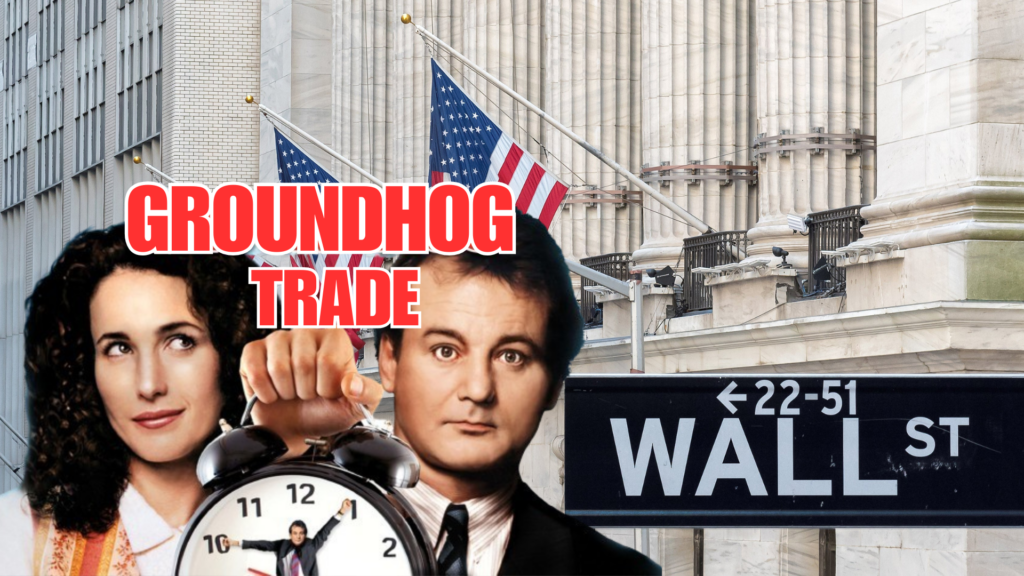
I usually wake up between 3:30 and 4:00 a.m. to read everything and tell you exactly what to think or know about the financial markets by 7:00 a.m. But with everything happening lately, I might have to rethink my schedule—or just give up on sleep altogether—to make sure I don’t miss anything and stay sharp in the morning. The problem? Every day feels like a rerun. The same market manipulations from the White House, the Élysée’s Adjudant-Chef Chaudard charging into battle, and the Germans once again getting their hands on the Bundestag’s checkbook. It’s the same show on repeat—just with different headlines.
Disneyland and Its Rides
Let’s try to summarize yesterday’s events as simply as possible. There was a time when we could almost try to anticipate what would happen after, but right now, it’s hard to even imagine an after—because in the span of three days, we can flip our stance four times, change our opinion eight times, rebalance our portfolios every five minutes, and consider 14 different investment strategies per half-hour. And all of this while knowing that it would take just one of the clowns in power somewhere in the world to lose it for reasons unknown, forcing us to completely rethink our carefully considered forecasts from just 30 minutes earlier.
Just look at what’s happened to the U.S. indices over the past two weeks! The only thing that comes to mind when looking at the S&P 500 charts is that WE’RE LUCKY MARKETS CAN ONLY GO UP AND DOWN—because if they could also move left and right, I’ll let you imagine the complete disaster that would create. In just two weeks, volatility shot up from 14% to 26%, and now we’re back at 21%, which seems to be the “new normal.” The Greed and Fear Index is all over the place and doesn’t make any sense anymore. As for the S&P 500, it’s clinging to the 200-day moving average but mostly looks capable of flipping from total panic to “bull market forever” in a matter of three minutes. All it takes is someone from the White House coughing or sneezing, and we’re back on the rollercoaster.
During Trump’s previous term, it was already a spectacle, but now that he’s back, we’ve had to install defibrillators in every trading room, and checking your blood pressure is mandatory every time you grab a coffee.
There’s Band-Aids in the Air
For once, let’s start with the U.S. this morning. To put things in context, on Tuesday night, we collectively freaked out when we realized that the one-month reprieve Trump had given the Canadians, Mexicans, and Chinese had just ended. Yes, it’s ALREADY been a month—but at the same time, it was an insanely short month. February is always a short month, but this time, we really felt it.
SO. The reprieve was over, meaning it became ABSOLUTELY necessary to RE-PANIC, just as we had done a month earlier. The markets got wrecked, and the S&P 500 miraculously held its 200-day moving average. Then, on Wednesday, we went back to RE-TEST it. Just for fun. Kind of like when you wave your hand over the fondue burner to see if it’s on, because like an idiot, you forgot if you already checked.
And just when the markets decided to play the let’s scare ourselves again game, Trump pulled his Chinese torture device back into play, and the market rebounded just enough to save face. But with volatility still at 21%, it’s safe to say that traders haven’t fully accepted that we’ve made it out of the woods—or rather, out of the hole at the bottom of the woods.
Trump’s Chinese Torture Device
If you’re wondering what that is, well, it’s simply Trump announcing brutal, violent, massive rules that will inevitably have economic and especially inflationary consequences. Rules that force you to panic and step out of your comfort zone. Then, just when you’re starting to consider slitting your wrists with a butter knife, opening a bed-and-breakfast in the South of France, or buying an RV to start producing meth, the President of all Americans reverses his decision and explains that tariffs, YES—but not on car manufacturers. Well, not for the next month, anyway. So, you can go ahead and schedule the next panic for the auto sector on April 4, 2025—unless, in the meantime, all the manufacturers have relocated or built factories in the USA to make America Great Again, yada yada, you know the drill…
Discounted Tariffs
So yes, Trump revised his stance on car tariffs, and everyone realized it was suddenly much easier to breathe without that weight on their chest. Trump is basically the guy who drives a nail into your hand, and while you’re screaming in pain, he gives you a morphine injection so you don’t feel anything anymore. But deep down, you know that as soon as the morphine wears off—in a month—the pain will return just the same, with an infection on top.
Either way, the little game of “it goes away, and it comes back”—which was originally invented by a French electrician who tried changing a lightbulb while sitting in his bathtub just to see if it conducted electricity—was once again played by Uncle Donald, who is never late when it comes to stirring things up on Wall Street.
In addition to tariffs, we also got some macroeconomic reports that were more or less good, depending on your perspective. First, the ISM Services Index came in above expectations. This showed that the economy was still doing well in that area, but we were still warned that people were worried about upcoming tariffs, which could lead to unwanted inflation in the medium term. Since yesterday’s session was all about optimism, we took the news positively, while storing it in the “cautious, but let’s not think about it until Monday” section of our prefrontal cortex—the part that handles short-term memory. That way, we’re sure to forget about it over the weekend.
Then, after the ISM report, the ADP employment numbers came in. Normally, no one cares about this data, but this time, it was worth noting that job creation was really weak. The “experts” who had been working on these forecasts for six weeks expected 141,000 new jobs, but the actual figure came in at 77,000. Now, I’m not a math genius, but I think that’s almost “half of what was expected.” But don’t worry—they say it’s ONLY TEMPORARY, because we’re experiencing what they call an “ENGAGEMENT UNCERTAINTY.”
Yes, indeed, with Trump’s flip-flopping strategies, employers prefer to wait and see before hiring anyone. Let’s just hope this doesn’t turn into the same “temporary transition” as inflation did four years ago… Either way, Trump’s circus allowed the U.S. market to bounce back 1% yesterday, proving that, “for now,” the 200-day moving average is a rock. A peninsula. In short, it’s pretty solid.
Europe Gives ESG the Finger!
In Europe, two main points stood out. First, Germany just found an old checkbook in a drawer and is about to go on an uncontrollable shopping spree. Second, the war against Russia continues to pour money into the arms industry.
The arms industry has become politicians’ new best friend—starting with Sergeant Macron, who told his beloved people last night that everyone would fight together to protect the country. He declared:
“Our generation will no longer enjoy the dividends of peace. It is up to us to ensure that our children will one day reap the dividends of our commitments.”
Coming from a guy who doesn’t have children and lives with a “woman” well past menopause who spends her time at Fashion Week while her “husband” plays with matches at the Élysée Palace, one has to wonder about the future of Europe.
But let’s move on, because that’s not the point. Yesterday, statements from both Berlin and Paris caused the European market to soar, recovering everything it had lost due to tariff concerns the previous day—and then some.
Starting from the beginning: On the German side, the new German chancellor announced that he would inject hundreds of billions of euros into defense and infrastructure. This has caused stocks to rise sharply, with some analysts calling it a “catalyst” for a broader economic recovery across Europe. Germany will launch a special fund of 500 billion euros over 10 years to renovate infrastructure and boost the economy, while also scrapping the debt brake mechanism that prevented the country from spending freely on armaments. Military spending could therefore reach at least 100 billion euros per year, double the current level. We’re talking about a total envelope of 1,000 billion euros over 10 years. If Germany doesn’t become the world champion of football with that, I don’t know what will. In any case, the DAX loved it, and I won’t even talk about Rheinmetall. It was madness. After losing 3.5% the day before, the DAX gained nearly 3.4%, and at Rheinmetall, after losing 2%, it gained 7%.
French national anthem- Call to Arms
Germany exploded yesterday, and the arms industry is feeling reinvigorated. Once again. It is true that the theme of investing in tanks, weapons, munitions, missiles, maybe even—let’s get crazy—chemical weapons and cluster bombs, has given the arms sector in Europe a new lease of life. The performance of Thales, Rheinmetall, and Dassault Aviation now rivals that of AI giants, who have been relegated to the back of the stock market, since no one talks about Nvidia anymore ever since Trump started cuddling up to Vladimir from Moscow. As I mentioned earlier, last night, Chief Warrant Officer Chaudard… uh, sorry, Chief Warrant Officer Macron explained to the French that they would have to fight to protect France and that they would all be brothers—yes, well, he won’t be getting shot at on the front line because he needs to hold the fort in Paris, but by the way, if we could lend him a little money to buy some ammo, that would be nice. But most importantly, the French are all brothers in arms now, and there are NO MORE problems concerning domestic politics because it’s war. In fact, it was the same speech as for COVID, except instead of using the words COVID or VIRUS, he used the word Putin.
But whatever, what’s really interesting for us investor-soldiers is that in the past 24 hours, ALL THE POLITICIANS from the Macronist or European camp are now talking about “financing rearmament,” appealing for private funds, and changing regulations to allow investment in armaments—which, let’s be clear—didn’t really fit into the responsible investment criteria, it must be admitted. So suddenly, after almost 20 years of development and implementation, ESG criteria have become almost as popular as Chlamydia or Gonorrhea. Anyway, in the end, the financial markets are doing great, everything is going up because of war, everything is going up because we’re going to spend billions that will tap into pension funds and (maybe even) because we’re no longer ashamed to say it: we’re going to tap into private savings. In fact, Europe is like the Sheriff of Nottingham, picking pockets from children’s piggy banks, the elderly, and the disabled. And no one says anything. We can only hope that Robin Hood shows up. In short, the war in Ukraine and Germany’s spending are making European markets rise…
As the saying goes, buy at the sound of cannon fire, and sell at the sound of the trumpet… unless it’s the other way around…
The rest of the wonderful world of military madness
On the Asian side, it’s a village celebration, everything is in the green. Japan is up 1% because they are happy about Trump’s temporary backpedaling, and then China is up 1% too, with Hong Kong almost 3% higher because China announced new fiscal stimulus measures at the National People’s Congress yesterday. Prime Minister Li Qiang emphasized strengthening domestic consumption and technological innovation, particularly in artificial intelligence. As for oil, stocks continue to fill up, putting pressure on the barrel, which continues to sink. This morning, WTI is at $66.65, and the support levels are getting farther into the fog. Gold is at $2,926, and Bitcoin is trading at $93,000.
In other news, the CEO of Moderna bought $5 million worth of shares in the company, which caused the stock to explode by 16%. Then Marvell released its quarterly results, beating expectations and announcing guidance in line with expectations. That clearly wasn’t enough to support Mister Bull Market. The stock was hammered down 14% after the close. Abercrombie lowered its guidance, and the stock dropped 9%, while FootLocker exceeded expectations and jumped 5%. And then Deutsche Bank estimated that the decisions made by the German government could be compared to the fall of the Berlin Wall, and the amounts being invested in Europe are reminiscent of the COVID period. Suddenly, issues like debt, budgets, or economic crises no longer matter. The French Prime Minister could be covering up a 30-year-old pedophilia scandal, and no one would even talk about it.
This morning, futures are slightly down, and I don’t know if we should still be talking about economic figures or macroeconomics, since all the attention is on inspiring speeches by the greats, and we prefer spending our time making photo montages comparing Macron to De Gaulle. But let’s just say that I’m still obliged to tell you that the ECB will lower rates this afternoon, and who knows, Lagarde might even join the special forces. And in the US, there will be the Trade Balance and Jobless Claims reports.
That’s all we could say this morning. And still, there’s probably much more, but since I’ve far exceeded my quota, I’m going to go get dressed and head to the recruitment office to go save the world! Have a great day, everyone, and see you tomorrow, because they probably won’t want me there!!!